Hilma’s Ghost – Research at Casa Museo Leonora Carrington, Mexico City
Sharmistha Ray (2025)Text by Sharmistha Ray:
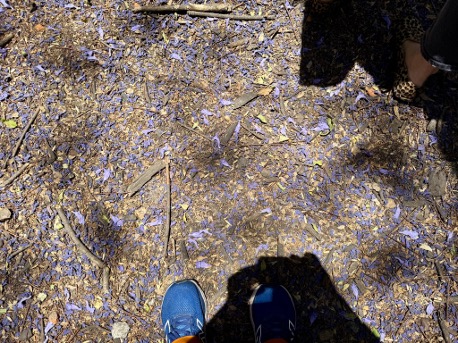
Mexico City arrives first as a gust of sensations: heat radiating off centuries-old stone, the brightness of jacaranda blossoms caught in exhaust and morning light, the soundscape of traffic horns threading through birdsong. The city is layered not only in architecture but in time—colonial facades built atop temples, contemporary galleries resting on the foundations of political struggle, murals speaking across decades. It is inside this living palimpsest that our research for Hilma’s Ghost unfolded, supported in part by the FRFF Grant.
Fig 1. Fallen jacaranda blossoms, Mexico City. Credit/Courtesy: Sharmistha Ray
We traveled to Mexico City as we prepared for our first solo exhibition there, La hora de la estrella (The Hour of the Star), held from April 12 to June 21, 2025, at Galería RGR in Chapultepec. This location is charged with feminist significance. Chapultepec and its surrounding arteries, including Paseo de la Reforma, have become central grounds for feminist protest, mourning, and occupation. The Casa del Bosque de Chapultepec was the site of a 1979 demonstration demanding free and unrestricted abortion, a gathering surveilled by the army; today, anti-monuments rise and disappear along Reforma, and statues are temporarily transformed into memorials for murdered women. Public space in this district is not neutral—it is contested terrain where women claim the right to inhabit the city safely, visibly, and without fear. Our exhibition thus unfolded in a geography already vibrating with feminist history and ongoing struggle.
Our project grew from a desire to enter into conversation with one of the great feminist, surrealist, mystical imaginations of the twentieth century: Leonora Carrington (1917 – 2011). Leonora Carrington’s artworks and writings teem with animal-human hybrids, colossal goddesses, mystical spaces for transformation, and enigmatic beings. She fashioned a diverse pantheon of subjects that eloquently express her fascination with the sacred, a concept unbound by any particular religion or culture and its existence within the innermost recesses of our psyche. We wanted to step into her world not only through books and exhibitions but through the intimate spaces that structured her daily life—the rooms she inhabited, the tables she touched, the small studio where large visions took form. The FRFF grant allowed me to travel to Mexico City, to carry out this research, and to develop the artistic outcomes that became our exhibition.
The central purpose of our trip was a visit to the Leonora Carrington house, a site that hovers between shrine, archive, and contested institution. It is not open to the general public and no photographs were permitted; our documentation exists as memory, notes, and the quiet proof of a receipt.[1] The house has both atmosphere and architecture. Everyday objects remain in situ—her toothbrush beside the sink, books leaning together, papers resting in shallow piles—while mythic sculptures of hybrid beings by Carrington preside over portals with patient attention. The studio, modest and tucked into the upper structure of the house, makes almost unbelievable the magnitude of work produced there. Yet this is Carrington’s lesson: transformation arises from interiority rather than spectacle. The personal is political.[2]
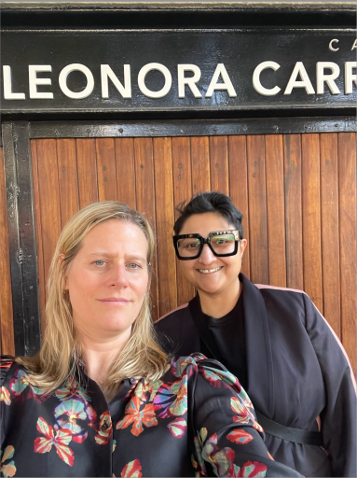
Fig 2. Dannielle Tegeder (left) and I (right) outside the Casa Museo Leonara Carrington. Credit/Courtesy: Hilma’s Ghost
We also carried the tension of working in relation to a white European woman who made Mexico City her home and whose domestic space has been preserved as a private monument. We hold that complexity while honoring Carrington’s formative role in feminist artistic lineages across Mexico and beyond. She did not come to be anyone’s muse; she came to be an artist, and this declaration reverberated through our research and practice.
Beyond the house, Mexico City itself became a co-researcher. The city is alive with feminist histories—murals, protests, archives, altars—and alive, too, with grief and resistance. The landscape bears witness to systemic violence against women: feminicide as both legal category and everyday horror, the names of the missing inscribed on buildings, and the massive gatherings in the Zócalo where mourning becomes public pedagogy. Marches such as Ni una menos and Vivas nos queremos transform the city into a living archive of refusal. Spiritual practices—copal smoke, prayers, amulets—interweave with protest, revealing a feminism that is embodied, ritual, insurgent, and communal.
Artists in Mexico City have long responded to this terrain. From Frida Kahlo’s mapping of the body as a sovereign yet wounded site, to Teresa Margolles’s stark confrontation with forensic realities of death, to Mónica Mayer’s participatory archives of testimony in El Tendedero, Mexican feminist artists have transformed grief into critical resistance. Younger artists build on these genealogies through decolonial, Indigenous, and queer lenses, blurring boundaries between research, ritual, pedagogy, and activism. We understood our work as entering this conversation rather than speaking over it.
A significant part of our practice is based out of ritual-making and spellwork, which are at the foundation of our collaborative work. A sacred and magical altar forms the physical and spiritual locus of our studio around which all other activity in the studio takes place. Our altar contains statues of deities and saints, burned down candles, crystals, sound bowls, incense, cedar sticks, herbal oils and dry herbs, active spell jars, small divinatory paintings and drawings, bells, and odd ends and paraphernalia we deem as having magical properties or that we have imbued with magic. This is where our rituals take place. Rituals can range from chanting, candle-burning, and affirmations, to creating spell jars, spellwork, and smudging.
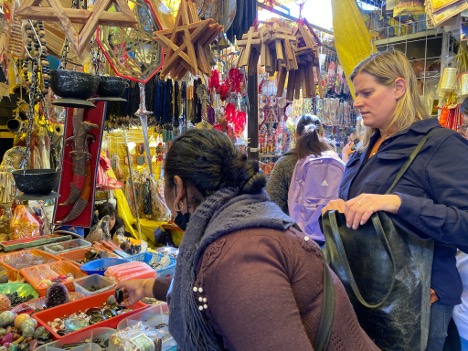
Markets are repositories of knowledge in their own right and one in particular became a site for Hilma’s Ghost research while in Mexico City. At Mercado de Sonora, magical paraphernalia—snakeskin, coral, dried herbs, oils, votive candles—are displayed not as curiosities but as tools used daily by women, healers, and brujas for protection and survival. Just beyond the city, ancient pyramids rose from the earth, echoing the sacred geometries that became amplified in the work for our show. These experiences braided together feminist history, spiritual technologies, and artistic inquiry.
Fig 3. Shopping for magic supplies at Mercado de Sonora. Credit: Sharmistha Ray / Courtesy: Hilma’s Ghost
Sigil Poems (2025 – )
I didn’t have time to be anyone’s muse… I was too busy rebelling against my family and
learning to be an artist.[3] — Leonora Carrington
A sigil is a symbol or design that is created with a specific intention, often used in magical or spiritual practices. The idea behind a sigil is that it can act as a form of symbolic representation of a desire, goal, or concept. The process of creating a sigil typically involves turning a phrase or intention into a visual form through a series of steps like condensing the letters of the intention, removing vowels, and then combining the remaining consonants into a unique design. Sigils are used in various mystical, occult, and magical traditions, such as chaos magic, and are believed to carry power or energy that can help manifest the user’s will. In these practices, a sigil is often seen as a tool for focusing the mind and directing energy toward a particular outcome.
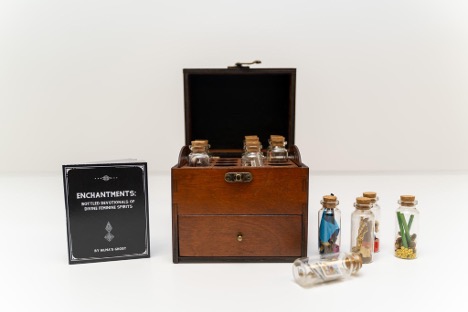
This series of Sigil Poems developed directly out of our engagement with our research in Mexico City. The first two concrete poems are rooted in the language and imagery of Leonora Carrington and Sor Juana Inés de la Cruz (1651–1695), both of whom shaped the feminist psyche, albeit in different periods, in Mexico. Sor Juana Inés de la Cruz was a poet, dramatist, scholar, and nun, and an exemplar of the Latin American colonial period and Hispanic Baroque. As a female, she had little access to formal education and would be almost entirely self-taught. Her criticism of misogyny and the hypocrisy of men led to her condemnation by the Bishop of Puebla, and in 1694 she was forced to sell her collection of books. Both these figures came into sharp focus in our collective’s sphere during ongoing research of historical women artists, writers, and poets who transcended the limitations of their times to create enduring art and whose lives serve as inspiration for current and future generations of feminists. We have called upon Carrington and Sor Juana as our ancestors during many channeling sessions, and they were both included in a special project we created for The Aldrich Contemporary Art Museum in 2022. This project, entitled “Enchantments: Bottled Devotionals of Divine Feminine Spirits,” consisted of an apothecary box with 12 spell bottles, each dedicated to a different woman artist, deity, or saint. The box was accompanied by a user manual with instructions on how to manifest the qualities of each of the personages that the spell jars represented. Carrington was represented with objects that included miniature paints, horseshoe, dried jalapeno pepper, and amethyst and the listed attributes were: vivid imagination, alchemy and ritual, metamorphosis, sorcery and dreamwork, creative prowess. Sor Juana was represented by poetry fragments, quill, silver glitter, and obsidian, and the listed attributes were: women’s rights, dramatic arts and poetry, benevolence, determination, passion.
Fig 4. Hilma’s Ghost, Enchantments: Bottled Devotionals of Divine Feminine Spirits, Apothecary box with 12 spell bottles with ephemera and guidebook, 2023. Credit: Gloria Perez / Courtesy: the artists and The Aldrich Contemporary Art Museum, Ridgefield, CT
The idea to combine Carrington’s poem “The Snake” with sigils came to us when we saw the reproduction of her magnificent intaglio print, Beasts: Snake (1998), which looks like a sigil. The snake has myriad symbolic associations, both healing and malignant, throughout ancient and modern cultures. Some of these meanings relate to renewal and transformation, healing and medicine, wisdom and intuition, earth and fertility, danger and temptation, feminine power, kundalini energy, protection, and good luck and good fortune. (It’s not lost on us that, in Chinese astrology, 2025 was the Year of the Snake). The body of the snake in Carrington’s drawing is wound into a reverse S-shape, its crown sprouting spirallic forms, enclosed in a circle. The top part of the design is further framed by a triangle which meets the top of the circle. The three corners of the triangle are finished with tiny crescents. The end of the snake’s tail meets the lower point of an inverted diamond which frames the lower half of the drawing. The lowest point of the diamond is also enclosed in a circle. This deceptively simple image deftly uses geometry, archetype, and language to create a sigil-like symbol with mystical underpinnings. Since we were working on a new animation for our Mexico City exhibition, we wanted to see how movement could generate a new way of creating a sigil from the poem. In our research of poems by other historical Mexican feminists, we found “You Foolish Men” by Sor Juana, which is a profound and incisive condemnation of patriarchy rooted in men’s callous and unjust behaviour towards women. It begins:
You foolish men who lay
the guilt on women,
not seeing you’re the cause
of the very thing you blame;
These two poems presented a beginning to a new series of works of animated sigil and concrete poems which act as visual spells for feminist resistance and transformation. Subsequently, we have grown the Sigil Poems to include contemporary feminist poets.
Poem citations:
Carrington, Leonora. “The Snake,” from The Seventh Horse and Other Tales (Virago Press, 1988). Sor Juana Inés de la Cruz. “You Foolish Men,” translated by Alan S. Trueblood, Poems, Protest, and a Dream (Penguin Classics, 1997).
Link to Sigil Poems:
Leonara Carrington: https://youtube.com/shorts/O5-FypBXQE8?feature=share
Sor Juana: https://youtube.com/shorts/ItgTk2_oLug?feature=share
La hora de la estrella (The Hour of the Star) (2025)
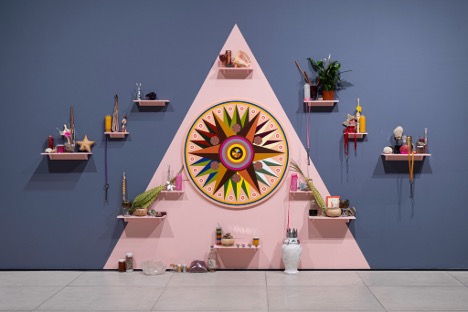
Fig 5. Hilma’s Ghost, Feminist Altar, 2025, Mexico City, variable dimensions. Courtesy: Hilma’s Ghost and Galeria RGR
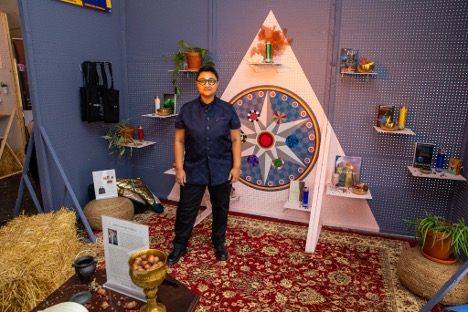
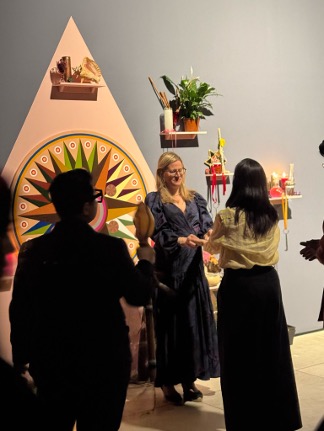
The feminist altar that anchored our solo exhibition arose directly from this matrix of history and sensation. We constructed a pink triangle—a queer signifier, energy vortex, and echo of pyramid geometry—and built shelves holding objects gathered from Mercado de Sonora in a divinatory way. On opening night, we invited the local feminist community, including artists, activists, and writers, to ceremonially complete the altar. Our comrades brought personal offerings: small talismans, toys, written prayers, slippers, a Palestinian flag. Over the exhibition’s duration, the altar became a living monument of grief, protection, solidarity, and collective imagination.
Our practice in Mexico City was guided by reciprocity rather than extraction. We approached research as relational—listening, collaborating, and asking what we could give back. The FRFF grant enabled me to treat an artist’s house as both archive and living cosmology, to respond to feminist histories not only through scholarship but through artistic action, and to translate these encounters into animation, poetry, sigils, participatory altar-building, and exhibition-making.
Fig 6. Ceremonial offerings to the feminist altar. Courtesy: Hilma’s Ghost
Mexico City revealed itself as feminist terrain not because it is resolved or safe but because it is unfinished—charged by both danger and resilience, by systemic harm and radical care. To work there meant acknowledging thresholds between life and death, protest and ritual, art and activism. In the end, the city itself became our text, written across stone, market stalls, pyramids, and voices rising together. We leave it not concluded but ongoing, carrying its lessons into our work, our altars, our poems, and our commitment to feminist practice as invocation and intervention.
Resonances
After our solo exhibition in Mexico City, Hilma’s Ghost created a second Feminist Altar at Counterpublic during a two-day festival in St. Louis in October 2025. Conceived as a site of solidarity and collective resistance, the altar invited the public to contribute written petitions—desires, griefs, demands, and commitments—braiding individual voices into a shared feminist commons. Over the weekend, we received more than 100 petitions, each one becoming part of the living structure of the altar. At the close of the festival, these offerings were ritually burned, transforming private intention into a collective act of release and resolve, and affirming the altar as both a space of care and a catalyst for political and spiritual resistance.
Fig 7. In front of our public feminist altar at Counterpublic, October 24-26, 2025. Courtesy of Counterpublic. Credit: Tyler Small
Bibliography:
Fajardo-Hill, Cecilia, and Andrea Giunta, eds. Radical Women: Latin American Art, 1960–1985. Los Angeles: Hammer Museum and DelMonico Books/Prestel, 2017.
Haskell, Caitlin, and Tere Arcq, eds. Remedios Varo: Science Fictions. Chicago: Art Institute of Chicago/Yale University Press, 2023.
Moorhead, Joanna. Surreal Spaces: The Life and Art of Leonora Carrington. Princeton, NJ: Princeton University Press, 2023.
[1] Maya Pantone, “Plans to Turn Leonara Carrington’s Home Into a Museum Scrapped,” Hyperallergic, October 24, 2024. https://hyperallergic.com/plans-to-turn-leonora-carrington-mexico-city-home-into-a-museum-scrapped/
[2] Leonara Carrington’s book, The Milk of Dreams, became the title of the 59th International Art Exhibition, La Biennale di Venezia, curated by Cecilia Alemani, April 23 – November 27, 2022. It featured many overlooked art historical female Surrealists and artists drawing from the occult.
[3] Quoted on MoMA’s website: https://www.moma.org/artists/993-leonora-carrington
This project was made possible with support from the Frank-Ratchye Further Fund #2024-055.