In the parlance of archival professionals, Kleymeyer’s approach might be called “postcustodial.” A traditional archive collects materials and physically hoards them within its walls, but the postcustodial archivist asks how archival skills might be “lent out” without materials being brought in. For instance, an archivist might visit the home of an ethnobotanist, digitize her photographs for her, and conduct an oral history. The digital files and transcripts would be left with the ethnobotanist, who could share or distribute them as she likes. Her story remains in the context, the social ecology, of its making. She might strike a deal with the institutional archive to pass along part of these materials at her death, but not necessarily. This approach removes one of the archivist’s primary roles: custodian of materials. What remains is the archivist’s other primary role—archivist as organizer.
In an archive, a life is organized into themes, decades, and projects. A series of documents might be held together by a degree program or a big achievement. Others, less thematically coherent, might be grouped together by year. Correspondence is often organized by correspondent—letters from G. Lankton and letters from B. Kleymeyer kept apart from one another. Archives are convenient fictions, but nothing on this organic earth has the stability and self-enclosure an archive might imply. Greer Lankton’s materials at Mattress Factory are organized in the traditional fashion: series labeled 2D Artwork, Correspondence, Ephemera and Administrative Papers, Journals, Photographs, Photo Albums, Periodicals, or Slides and Negatives. In some ways, the collection gives me what I asked for: It organizes Lankton’s materials so as not to collapse her life into a single point. It does so by making Greer Lankton into anybody, into nobody, into someone whose material traces can be organized by medium.
The archive puts the archivist’s mind at ease. The archive takes possession, turns a thing into a resource: something from which we can extract.
We learn the body in systems, but systems are heuristics of convenience. The pain of a broken bone crosses lines of mineral, muscle, blood, and synapse. When a body is reformed—by medicine, childbirth, grief, or nights of chemical bliss—do those reformations not reform the entire body? Do they not exceed the targeted system, not introduce corpuscles of mockery into our attempts at distinction?
Kleymeyer says she’s curious how else we might organize a life. Greer’s diaries and photographs show a lifetime of hairstyles, for instance. Kleymeyer says she could organize her own life based on the beds she has owned. In As Others Have Before, Kleymeyer takes a more poetic approach to the question of organization. By continually moving between her own story and Lankton’s, Kleymeyer brings Lankton’s story—a story of studio art, of love, of family friction and support, of moving and trying and failing, and, yes, of transition—back into the present. At the same time, photocopies of Lankton’s documents circulate through the room. A final organization doesn’t take shape, but the process which instigates organization does. Here, a life, an archive, is organized by the moments when it ceases to be one’s own life and becomes ambiguous with the lives of others. Perhaps the work resonates well here in Pittsburgh because it is, as Kleymeyer puts it, a place where people are “collecting things to save places.” As gentrification and greedy property development reshape this city, as they are doing in most cities, Kleymeyer says residents are interested in holding onto touchstones, maybe talismans, of what has been lost in the flux of change. Through these objects, residents narrate stories about what came before, as well as what they think might come next
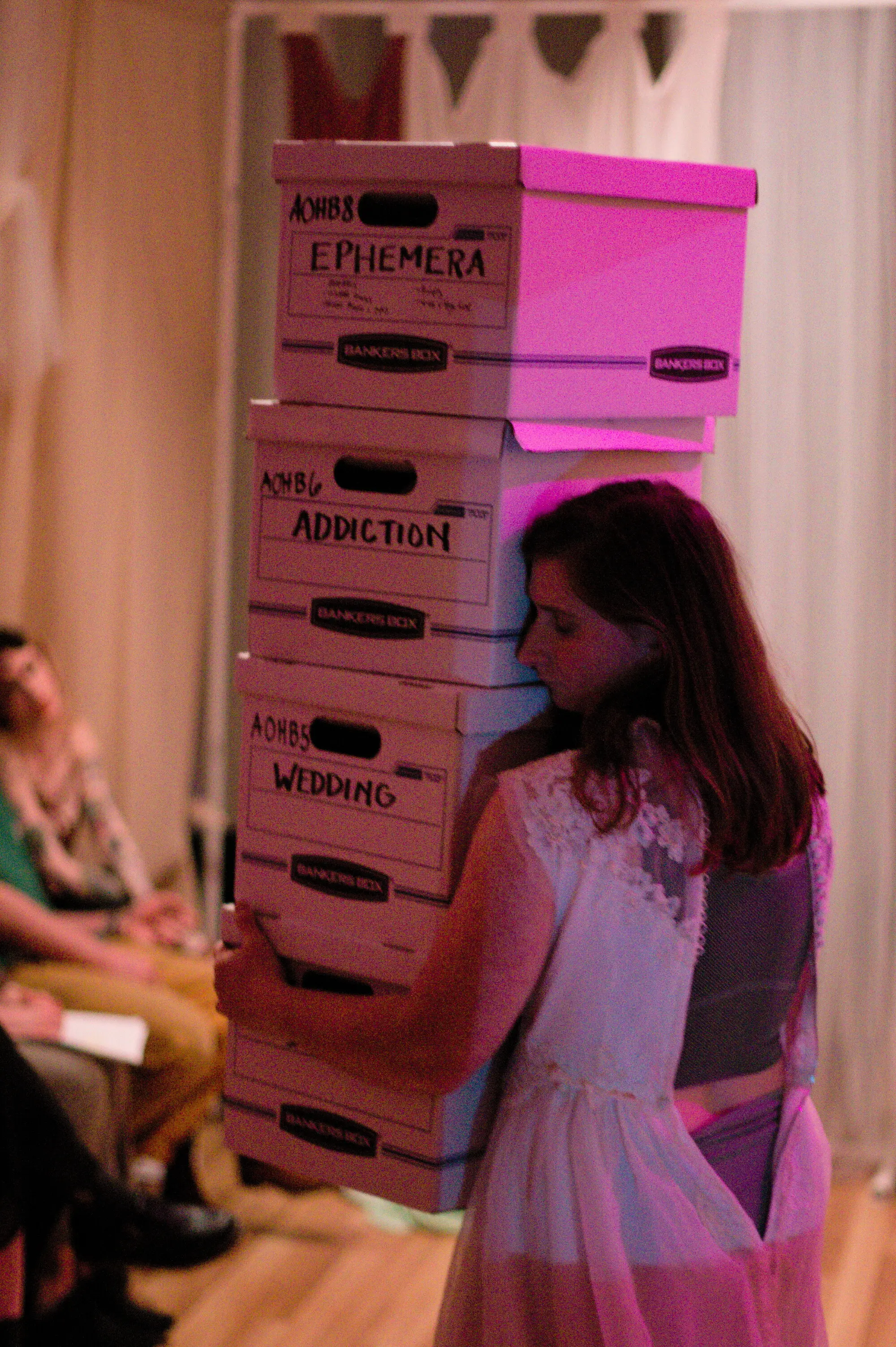
When Kleymeyer’s lover—her stack of archival boxes—slips away and hits the floor, spills open, it is—perhaps—a way of rejecting the crisis of forgetting which is the premise of the archive.
“What comes next?” is a provocative question because it refuses to unthinkingly promulgate what already is. After sorting through documents, handing them out to attendees, and talking through two life stories, Kleymeyer dons a white wedding dress and slowly dances with a stack of archival boxes, which she holds in her arms. The dress indexes Kleymeyer’s own emerging desire for familial connection and stability, but it also ties her—through longing and curiosity—to Lankton’s wedding. She is, maybe as all brides are, a composite image. Kleymeyer’s movements in dance are sweet and delicate. Then, she slips on the train of fabric and the stack falls forward, hitting the floor and spilling contents outward. For a moment, she seems to sort through the fallen boxes before finding a diary from which she reads aloud. The pace of the text, which had previously been metered and even welcoming, becomes distressed. The entries, more like strings of words than coherent narratives, pull frantically at Lankton’s own stories of health anxiety, family conflict, the death of friends from AIDS, and the disappointments of living.
There is a fire in the mind of the archivist or, better yet, a flood. And there is a desperate need to rise above a crisis—a disaster, a war, or the benign neglect of time. Everything in an archive is there because, otherwise, it is considered at risk. The archive puts the archivist’s mind at ease. The archive takes possession, turns a thing into a resource: something from which we can extract. It both produces the resource and warns us of its non-renewable nature. “If you don’t save these things,” the archive seems to say, “then the questions can never be answered.”