Metal Clay
Priyanka Acharya and Jenna Boyles (2026)
Priyanka and Jenna created a series of small metal clay sculptures, jewelry, and beads that can be combined and used within circuits as conduits and sensors. Individually, each brought their knowledge about jewelry making and electronics to the project, but neither had ever used metal clay. Their research goal was to create metal clay samples that could later translate into wearable and interactive sculptures in combination with circuitry.
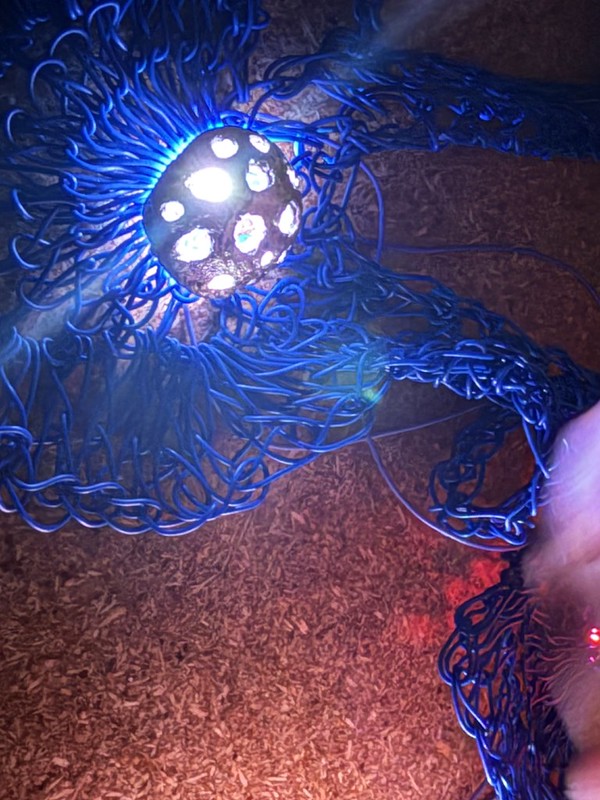
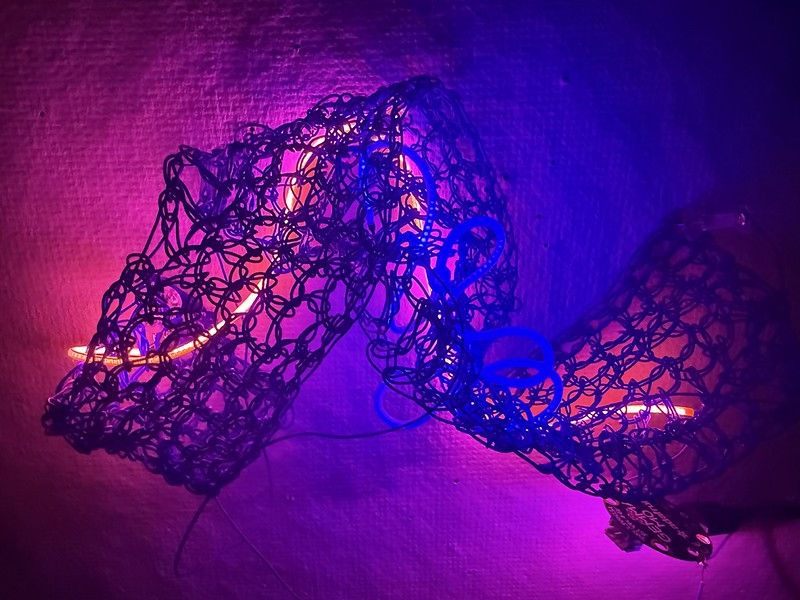
To explore these possibilities, they created a series of copper and silver elements to interface with our circuit designs. They used crocheted electronic wire-wrapping wire and both jewelry-making and electronic soldering techniques to integrate our custom pieces into a library of samples. The final piece grew out of these experiments and was programmed with pulsing individual LEDs and flexible LED filament. Glow in the dark 3D filament has an interesting semi-translucent quality that allows light to shine through both it and the crocheted wire to create unique shadows. When the medallion, (“eye” of the octopus) is touched, the light pattern responds in a new pattern. When the lights of the piece are dim or off, the reactive filament can be seen giving off a subtle glow. Even if the entire work is not receiving power from an outlet and responding to an environment we intentionally created, it is still sensitive to the natural lighting in whatever environment it is placed.
Their inspiration for this project comes from early electronic jewelry designs by Gustave Trové and neon pieces by Keith Sonnier. Bioluminescent sea creatures such as anglerfish and jellyfish, along with the fascinating sensory facts about octopuses, led us to our final abstracted form. Octopuses are the closest animal we have to aliens and essentially have a brain in each tentacle which allows them to each move independently and see the exact color and texture of their surroundings. The various textures, colors, and visual stimuli in our final piece tries to capture the complexity and beauty of these wild creatures.
This project was made possible with support from the Frank-Ratchye Further Fund #2026-006. Additional images are available here.