How to Turn to Stone
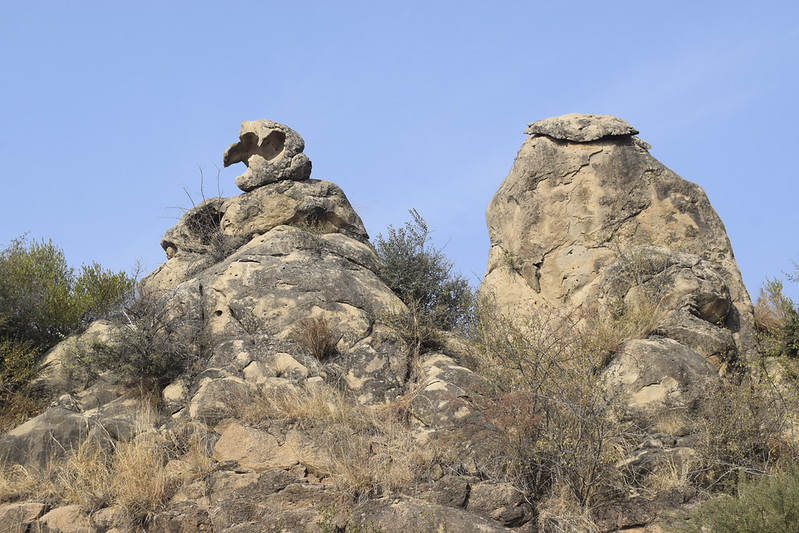
Aleena Akbar (2025)Aleena Akbar Khan’s project began with a stone found near her grandmother’s village in rural Pakistan, allegedly shaped like a man and a woman embracing. The myth around the stone is that it took its form in the aftermath of the displacement of 1947, when the British imperial government partitioned the Indian subcontinent into India and Pakistan, which forced a massive displacement across the subcontinent.
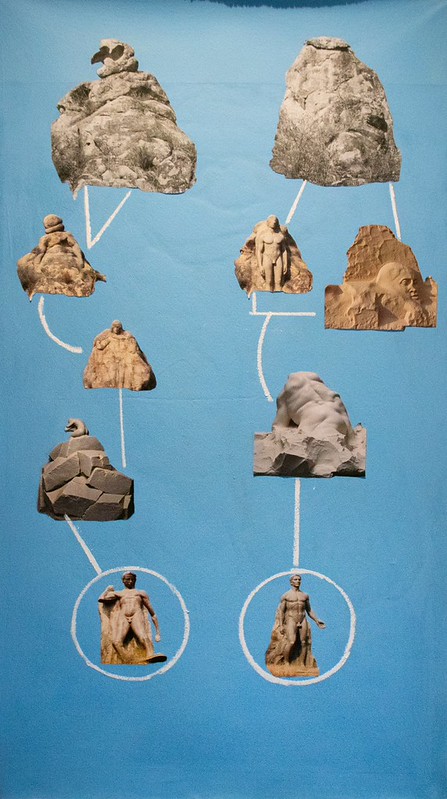
Akbar Khan’s project culminated into a body of drawings and a video work. In her words, the cycle of drawings at the center of this project takes that stone as both origin and destination. In the evolutionary arc she proposes, the human body emerges from stone—two stones strike together to make a pointed stone, the pointed stone becomes the first weapon, and from that weapon, the human hand is born. Perception and cognition follow the same logic: the first spark of fire produces the eye; as the spark grows, so does the brain. Evolution here is a cycle that returns to where it began. We came from stones. We are, today, stones.
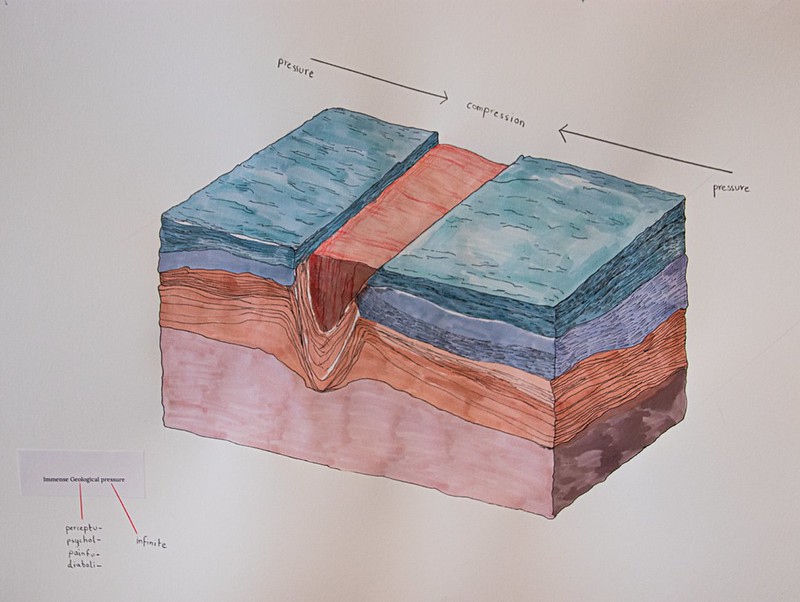
The project began as a meditation on political sovereignty forced upon the human body; Akbar Khan renders this in the mode of scientific and technical realism, which is the visual language of the biological diagrams she first encountered in school textbooks. She says that before she understood abstraction in art, those drawings were her introduction to it. Scientific picture making remains the most compelling abstraction to her, because science constructs models of time and space through the combined manipulation of language, symbols, and image. For something as ostensibly linear as Darwinian evolutionary theory, science produces a timeline. No person has ever inhabited a timeline. Time itself remains one of the most contested and unresolved problems across mythology, religion, and science alike. The work locates the cycle of evolution in the specific weight of political sovereignty, distance of diaspora, partition and time.
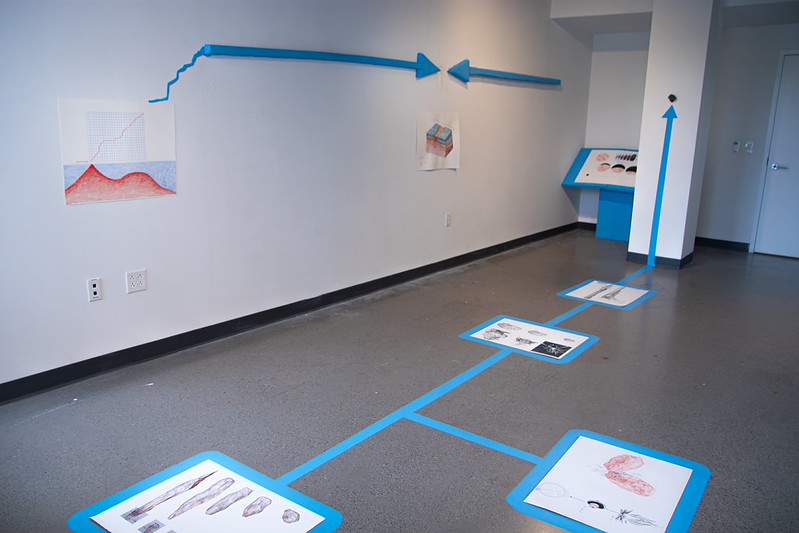
The video plays with these themes in a satirical sense, mixing humor, levity, museological narratives with oral history. Akbar Khan collaborated with the curators of the Gemstones section in the Carnegie Museum of Art, and stitched together footage from her interviews in rural Pakistan.
List of Collaborators:
Local community in Dhokri, Pakistan (Rural Punjab)
Curators of the Gemstone collection at Carnegie Museum of Natural History
This project is made possible in part with support from the Frank-Ratchye Further Fund Grant #2025-061. Additional images available here.