AI Summer Tool Making Residency 2026
Britt Ransom, Golan Levin, Heather Bizon, Daragh Byrne (2026)Initiated by Professor Daragh Byrne, the STUDIO was home to a jury selected faculty research residency to build AI-driven tools for artists during Summer 2026. Each faculty residence received project funds and a budget to pay student research assistants for a one-month project period.
Golan Levin (Art), Britt Ransom (Art), and Heather Bizon (Architecture) formed a cohort that met once a week to discuss their progress and share resources toward the development of public presentations. Watch their interviews below to learn more about their findings.


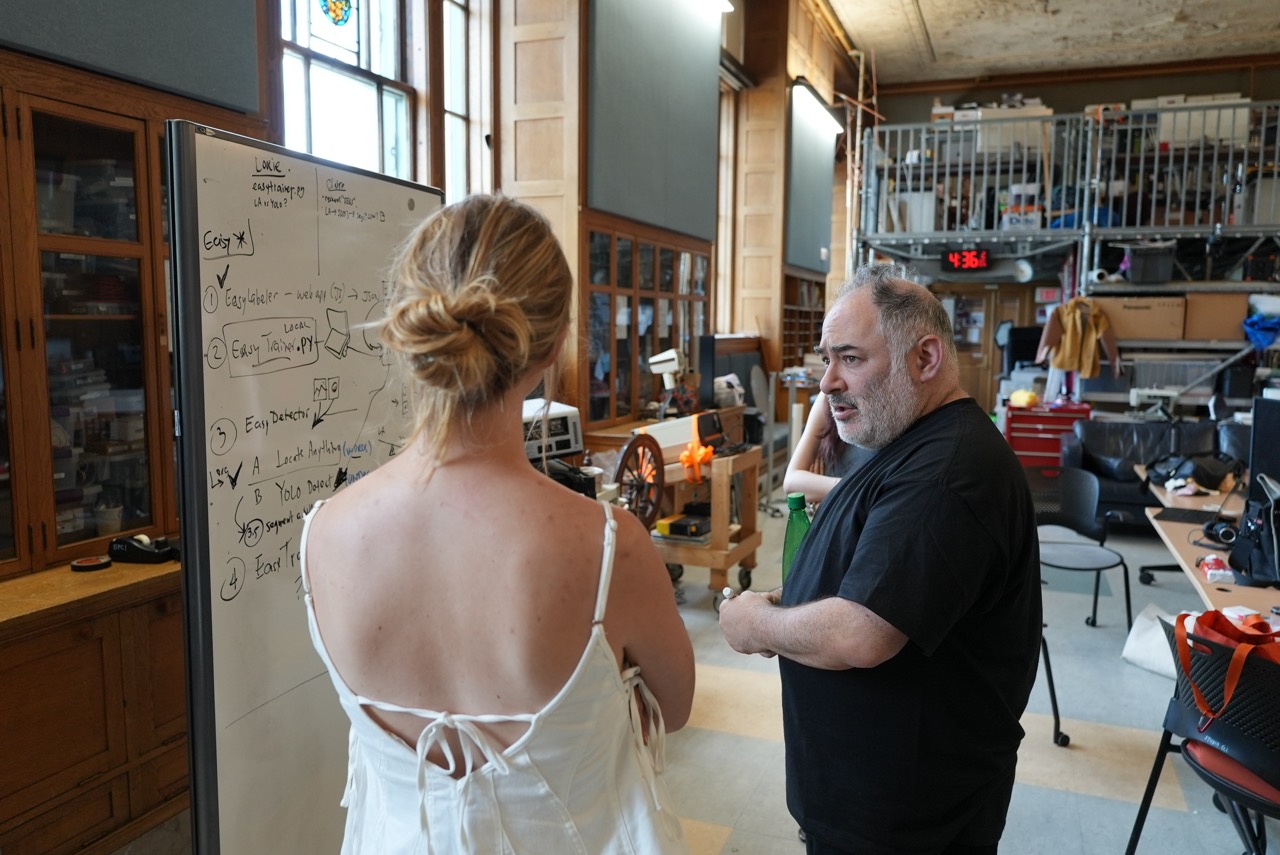
Golan Levin, Claire Vlases, Lorie Chen
“Easy Vision”
Rather than treating AI primarily as a system for image generation, EasyVision and ComfyCV use contemporary computer vision models as instruments for observation, measurement, and analysis. The toolkit is intended for artists, designers, educators, and students who wish to build their own workflows for computational perception using open, modifiable software. For more information, see About EasyVision & ComfyCV.
Britt Ransom, Aleena Akbar Khan
“The Unmodeled Object”
The Unmodeled Object is a pedagogical toolkit for digital fabrication courses that responds to a rapidly emerging challenge in art and design education: widely accessible AI 3D generators can
now produce complex forms before students understand how those forms are modeled, translated into physical objects, fabricated, or critically evaluated. Rather than treating AI as a
new technical skill or a shortcut to production, the project positions AI generated models as the beginning of a broader process of research, observation, digital reconstruction, and material
investigation. The residency produced three classroom assignments, accompanying workflows, and teaching strategies that ask students to move between photography, prompting, AI 3D
generation, digital modeling, fabrication, field research, archival investigation, and curatorial thinking. Throughout each assignment, students are asked to repeatedly shift between digital and
physical processes, using AI generated objects as opportunities to question authorship, translation, materiality, and the relationship between computational systems and object making.
Heather Bizon, Ryan Shen
“Little Bird”
Little Bird is a play-based ecological sensing tool that integrates physical collection devices, site-based stations, and AI-assisted data interpretation to support environmental learning. The project develops a toolkit that enables children to collect, record, and interpret observations of birds, plant life, and environmental conditions through guided play.